
Neutron Star Collisions: The Cosmic Factories Creating Gold and Platinum
The universe is a vast and mysterious place, home to countless phenomena that challenge our understanding of physics, matter, and the origins of the elements we encounter every day. Among these phenomena are neutron stars, the remnants of massive stars that have undergone supernova explosions. When neutron stars collide, they unleash an incredible amount of energy and produce elements heavier than iron, including precious metals like gold and platinum.
What Are Neutron Stars?
Formation of Neutron Stars
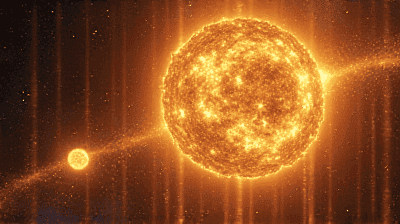
Neutron stars are one of the densest forms of matter in the universe, formed as the remnants of massive stars after they have exhausted their nuclear fuel. When a star larger than about eight solar masses runs out of fuel, it can no longer support its own weight against gravitational collapse. The core collapses under gravity, and if the remaining mass is sufficient, it compresses the protons and electrons together to form neutrons, resulting in a neutron star.
Characteristics of Neutron Stars
Neutron stars exhibit fascinating properties:
Density: A neutron star is incredibly dense—one teaspoon of its material would weigh about a billion tons on Earth. This extreme density is due to the compactness created by the gravitational collapse during the star's final stages.
Rotation: Many neutron stars are observed to be pulsars, which are rotating neutron stars that emit beams of radiation. As they spin rapidly, these beams sweep across space, creating a pulsating effect as seen from Earth.
Magnetic Fields: Neutron stars possess extremely strong magnetic fields, billions of times stronger than Earth's. This magnetic field affects the behavior of matter around the star and plays a role in the emission of radiation.
The Collision of Neutron Stars
What Happens During a Collision?
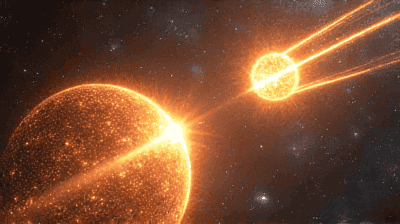
Neutron star collisions are among the most powerful events in the universe. When two neutron stars orbit each other in a binary system, they gradually lose energy through the emission of gravitational waves, eventually spiraling closer together until they collide. The collision produces an extraordinary burst of energy detectable across vast distances.
Gravitational Waves: When neutron stars collide, they generate ripples in spacetime known as gravitational waves. These waves were first directly detected by the LIGO observatory in September 2015, marking a significant milestone in astrophysics.
Kilonova: The collision also produces a kilonova, an astronomical event characterized by a bright light resulting from the ejection of material during the collision. Kilonovae can be observed in various wavelengths, including visible light, infrared, and gamma rays.
Matter Ejection: During the collision, a substantial amount of neutron-rich material is ejected into space, creating the conditions necessary for nucleosynthesis, the process by which heavier elements are formed.
Observing Neutron Star Collisions
The first observed neutron star collision was recorded in August 2017, when the LIGO and Virgo observatories detected gravitational waves from a merger designated GW170817. Following this detection, a series of astronomical observations was conducted across multiple wavelengths, including gamma rays, X-rays, optical, and radio.
Multi-Messenger Astronomy: The event marked a significant advance in multi-messenger astronomy, combining information from gravitational waves and electromagnetic radiation to provide a comprehensive picture of the collision. This approach enhances our understanding of astrophysical phenomena and the universe as a whole.
Afterglow Observations: The aftermath of the collision revealed a kilonova that was visible for weeks, providing critical data on the synthesis of heavy elements during the event. The light from this kilonova allowed astronomers to study the processes involved in nucleosynthesis and the isotopes produced.
The Role of Neutron Star Collisions in Element Formation
The Process of Nucleosynthesis
Nucleosynthesis is the process through which elements are formed in the universe. While lighter elements such as hydrogen and helium were created during the Big Bang, heavier elements are produced through processes that occur in stars and during catastrophic events such as supernovae and neutron star collisions.
R-Process: The rapid neutron-capture process, or r-process, is particularly relevant to the formation of heavy elements during neutron star collisions. In this process, atomic nuclei capture neutrons rapidly, resulting in the formation of unstable isotopes. These isotopes undergo beta decay, transforming neutrons into protons, ultimately leading to the creation of heavy elements like gold, platinum, iridium, and uranium.
Conditions Favoring R-Process: The extreme conditions present in neutron star collisions, including the high density of neutrons and the rapid ejection of matter, create a favorable environment for the r-process to occur. As neutron-rich matter is expelled, it cools and allows for the synthesis of heavier elements.
The Synthesis of Gold and Platinum
Neutron star collisions have been identified as a primary source of gold and platinum in the universe. Understanding how these precious metals are created during these events sheds light on the origins of the elements we find on Earth.
Observational Evidence: Studies of kilonovae associated with neutron star mergers have revealed signatures of heavy elements, including gold and platinum. The spectral lines of these elements can be detected in the light emitted during a kilonova, providing direct evidence of their formation during the collision.
Implications for Chemical Enrichment: The production of gold and platinum has implications for the chemical evolution of galaxies. As neutron star collisions eject heavy elements into the interstellar medium, these elements enrich the gas from which new stars and planets form. This process contributes to the overall chemical diversity of the universe.
The Broader Cosmic Context
The Universe's Heavy Element Inventory
The production of heavy elements through neutron star collisions plays a vital role in the cosmic inventory of elements. Understanding the contribution of these events helps astronomers and cosmologists piece together the history of element formation in the universe.
Sources of Heavy Elements: In addition to neutron star collisions, heavy elements are formed through other processes, including:
- Supernova explosions: When massive stars explode, they provide the energy needed for nucleosynthesis and release heavy elements into space.
- Asymptotic giant branch stars: These stars can also contribute to heavy element production through nucleosynthesis processes.
Galactic Chemical Evolution: The combined contributions of various processes inform our understanding of galactic chemical evolution. The presence of heavy elements in different regions of galaxies can provide insights into their formation histories and interactions.
The Cycle of Matter in the Universe
The creation of elements through cosmic events emphasizes the interconnected nature of matter in the universe. Elements born in violent collisions or supernovae can be recycled into new stars, planets, and even life on Earth.
Element Reuse: After heavy elements are expelled into the interstellar medium, they can become part of molecular clouds that form new stars and solar systems. This recycling process enriches the next generation of stars and planets, enabling the ongoing evolution of the cosmos.
Origins of Human Elements: The gold and platinum found on Earth ultimately originated from neutron star collisions and other cosmic events. Understanding where these elements come from reinforces our connection to the universe and the large-scale processes that shape it.
The Future of Neutron Star Research
Ongoing Observations and Research
The discovery of DNS mergers and their associated kilonovae has opened new avenues for astronomical research. Scientists are actively working to enhance observational capabilities and theoretical models to deepen our understanding of neutron star collisions and their consequences.
Advanced Gravitational Wave Observatories: Future gravitational wave observatories, including the proposed Einstein Telescope and LIGO upgrades, will enable more sensitive detection of neutron star mergers, increasing our ability to study these events.
Multi-Wavelength Observations: The use of current and future telescopes, such as the James Webb Space Telescope and extremely large ground-based telescopes, will enhance our ability to observe kilonovae and study their spectral signatures. This approach will help correlate gravitational wave data with electromagnetic observations.
Implications for Astrophysics and Cosmology
The study of neutron star collisions carries significant implications for our understanding of fundamental physics, the evolution of the universe, and the potential for life beyond Earth.
Understanding Fundamental Forces: Investigating the extreme conditions found in neutron star collisions can provide insights into fundamental physics, including the behavior of matter under extraordinary density and the interactions of nuclear forces.
The Evolution of the Universe: The synthesis of heavy elements and their distribution throughout the universe helps shape the structure and evolution of galaxies. By understanding the processes involved, scientists can better grasp the history of our universe.
Astrobiological Considerations: The creation of heavy elements during neutron star collisions raises interesting questions about the potential for life elsewhere in the universe. The availability of heavy elements in newly formed planetary systems could offer the building blocks for complex chemistry and life.
Conclusion
Neutron star collisions represent one of the most captivating and powerful phenomena in the universe. The events not only give birth to precious metals like gold and platinum but also enrich the cosmos, shaping the evolution of galaxies and the very fabric of matter throughout the universe. The insights gained from studying these extraordinary events deepen our understanding of nucleosynthesis, stellar evolution, and the interconnectedness of all matter.
As astronomers and physicists continue to explore the mysteries of neutron stars and their collisions, we are reminded of our place in the cosmos. The elements that make up our world, including those of gold and platinum, carry the imprints of ancient cosmic events. By unveiling the secrets of the universe, we uncover the connections that bind us to the vastness of space and time.
-
 Astronomy
White Holes: The Hypothetical Twin of Black Holes That Spits Matter Out
In the realm of theoretical physics and astronomy, the imagination often stretches into the unknown, leading to the development of concepts that challenge our understanding of the universe. Among these fascinating concepts is the idea of white holes, the hypothetical counterparts to black holes. While black holes are infamous for their ability to trap everything that crosses their event horizon, white holes are theorized to do the opposite: they expel matter and energy into the universe.
-
 Astronomy
The Kuiper Belt's Secrets: What New Horizons Found Beyond Pluto
The Kuiper Belt, a vast region of icy bodies beyond the orbit of Neptune, has long intrigued astronomers and planetary scientists. Home to a diverse collection of objects, including dwarf planets, comets, and potential new worlds, the Kuiper Belt offers a unique window into the early solar system. The exploration of this distant region gained significant momentum with the historic flyby of NASA's New Horizons spacecraft in 2015, which delivered the first close-up images and data from Pluto and its moons. However, the mission did not end there; it continued its journey deeper into the Kuiper Belt, revealing secrets about its structure, composition, and the origins of our solar system.
-
 Astronomy
The Great Attractor: The Mysterious Force Pulling Our Galaxy at 14 Million MPH
In the vastness of the universe, galaxies are in a dynamic ballet, influenced by the gravitational forces exerted by one another and by unseen structures. One of the most intriguing cosmic phenomena is a gravitational anomaly known as the Great Attractor. This mysterious region exerts a powerful influence on our galaxy, the Milky Way, and many other galaxies in its vicinity, pulling them toward it at incredible speeds. The Great Attractor is an enigmatic force that scientists are still working to fully understand, raising questions about the large-scale structure of the universe, the nature of gravity, and the composition of the cosmic fabric.
-
 Astronomy
Dark Matter Hunt: The Cutting-Edge Experiments Trying to Catch the Universe's Ghost
In the vast cosmos, a mysterious substance eludes direct detection while profoundly influencing the structure and evolution of the universe. This elusive entity is known as dark matter, a form of matter that does not emit, absorb, or reflect light, making it invisible to traditional observational techniques. Despite its ghostly presence, dark matter is believed to constitute approximately 27 percent of the universe's total mass-energy content. Understanding dark matter is one of the foremost challenges in modern astrophysics and cosmology.
-
 Astronomy
Satellite Swarms: How Mega-Constellations Are Changing Astronomy Forever
In recent years, the night sky has begun to look different than it ever has before. The proliferation of satellite swarms—groups of satellites operating together for various purposes—has profoundly transformed the field of astronomy and our understanding of the universe. These mega convolutions of satellites not only revolutionize how we observe and analyze astronomical phenomena, but they also present new challenges and opportunities for researchers and enthusiasts alike.
-
 Astronomy
The Fate of the Universe: Heat Death, Big Rip or Big Crunch?
The universe is an expansive and enigmatic entity that has fascinated humanity for millennia. As we delve deeper into the cosmos, we confront fundamental questions about its origins, behavior, and eventual fate. While our understanding of the universe's beginnings is grounded in the Big Bang theory, theories concerning its ultimate fate—whether it will end in heat death, a Big Rip, or a Big Crunch—remain at the forefront of cosmological research.
Hot Posts
-

Best Practices for Disposing of Pet Waste: Keeping Your Home and Community Clean
-

Insurance Premiums Explained: Factors that Affect Your Coverage Cost
-

The Environmental Impact of Food Waste: Why Proper Disposal Matters
-

Top 10 Foods You Should Never Dispose of in Your Garbage Disposal
-

Types of Insurance: Exploring Coverage Options for Different Needs
-

Why Subscription Boxes Are the Future of Retail